3.9 VR/AR specialist
Full visualisations for this profile are available in the dedicated section:
This profile includes 15 respondents. VR/AR specialists represent a small but highly technical group within the survey. Their workflows combine immersive technologies, 3D content creation, and interactive experience design, but adoption patterns vary widely depending on project scale, available data, and institutional support. The limited number of respondents means patterns must be interpreted cautiously, yet several consistent trends do emerge.
3.9.1 Digital tools, data acquisition, monitoring, challenges
VR/AR specialists rely primarily on 3D modelling software, game engines, and VR/AR systems, forming the core technological stack behind most immersive cultural heritage applications. Photogrammetry and immersive storytelling platforms complement this toolkit, while more advanced or specialised systems – such as structured–light scanners or motion–capture rigs – appear only in a minority of cases.
Real–time data use is limited: most respondents work with static or pre–recorded datasets, and only a very small subset integrates live or frequently updated information into immersive applications.
Practices to monitor performance, usage or experience of VR/AR applications follow the same trend: some professionals use interaction–tracking or performance–monitoring tools, but a comparable share does not rely on any digital monitoring system at all.
The challenges reported when working with data are primarily technical and infrastructural (Figure 36). Respondents cite platform constraints, data interoperability issues, and the substantial time required for data preparation and cleaning. Additional difficulties include limited access to accurate or high–quality reference data and institutional barriers to obtaining source material. Notably, no respondent indicated an absence of challenges, underscoring the persistent complexity of VR/AR work in the heritage sector.
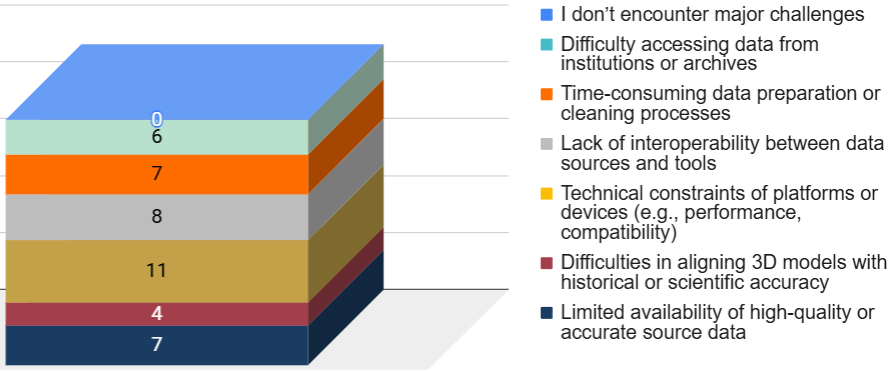
Figure 36. Working with data main challenges.
3.9.2 Data types, formats, standards
VR/AR specialists work with a focused but technically demanding set of data types. 3D models are the central asset, forming the foundation of most immersive experiences, and are commonly complemented by photographic material, audiovisual content, and selected historical or archival sources. Only a small minority engage with sensor–based or interaction data, reflecting the predominantly static nature of current VR/AR production pipelines.
The formats used to deliver content are similarly specialised (Figure 37): 3D model formats and game–engine project files dominate, together with standard multimedia resources needed for narration and visual support. Metadata files are used by part of the group, while motion–capture or spatial–audio formats are largely absent, suggesting that high–end immersive pipelines are not yet widespread in heritage–focused projects.
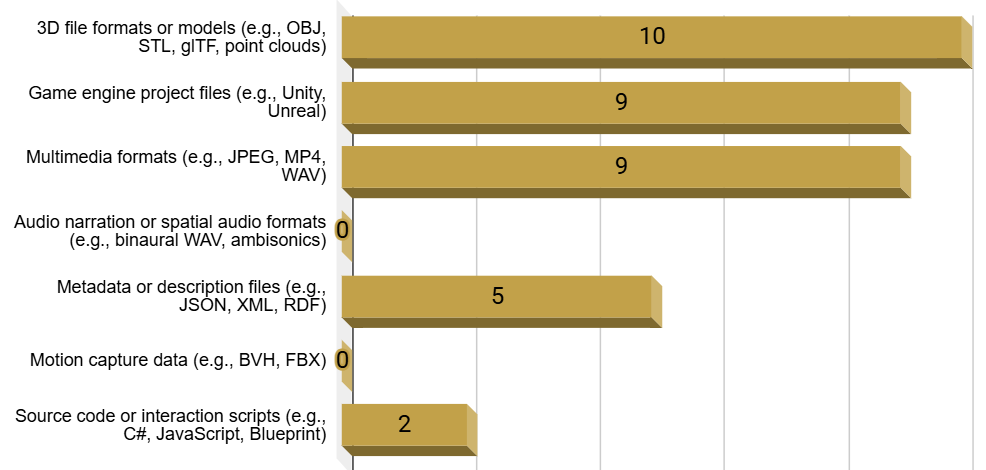
Figure 37. Data format.
Standards adoption remains limited. Apart from glTF, which emerges as the closest thing to a shared exchange format, only a few respondents report using structured models such as CIDOC CRM or X3D/WebXR. A substantial portion does not use any interoperability standards at all, highlighting an ecosystem where technical practice is advanced but still loosely connected to broader cultural heritage data frameworks.
3.9.3 Data accessibility, collaboration, and sharing
VR/AR specialists manage data that is only partially structured: while a few rely on formal digital systems, most work with materials dispersed across different platforms or stored in semi–structured formats. Fully unstructured or physical records still appear in several cases, reflecting workflows where technical production moves faster than institutional data governance.
Collaboration is common and tends to rely on external, flexible platforms such as GitHub, Trello, Slack or Notion, which better support iterative development and cross–disciplinary teamwork. Internal institutional platforms play a smaller role, though interest in adopting collaborative environments remains relatively high.
The main challenges in sharing data point to the hybrid nature of VR/AR heritage work. Professionals report limited interoperability, inconsistent standards for immersive content, and concerns around intellectual property when exchanging assets. The most widespread difficulty, however, is the gap between technical teams and heritage specialists, which complicates shared decision–making and slows down cross–disciplinary workflows. A minority reports no major obstacles.
3.9.4 3D models, simulations, and integration challenges
Most VR/AR specialists have hands–on experience with 3D models, which form the backbone of immersive heritage applications. Digital simulations are used less frequently but still represent a growing area of practice, with many respondents expressing interest even if not yet applying them directly.
Integration challenges reflect the distance between immersive development workflows and institutional heritage systems (Figure 38). Limited staff training and technical expertise emerge as the most widespread barrier, followed by budget constraints that restrict experimentation with advanced tools. Respondents also point to difficulties aligning immersive outputs with curatorial or interpretive objectives and to uneven compatibility with existing infrastructures or databases. Only one participant reports no major obstacles, confirming that integration remains a structural challenge for VR/AR work in cultural heritage.
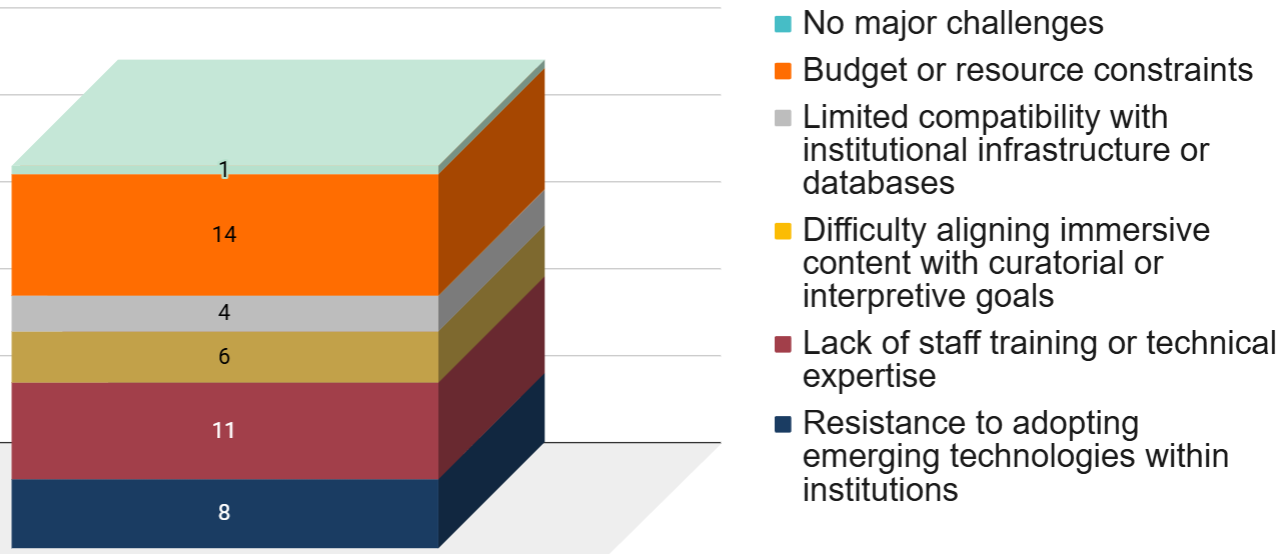
Figure 38. Main challenges in integrating digital technologies.
3.9.5 Digital Twin expectations and future perspectives
VR/AR specialists show a strong openness toward Digital Twin applications, particularly where they can enhance interpretive depth and experiential quality. Respondents see clear potential in areas such as interactive storytelling, educational engagement, and the integration of real–time information into immersive environments. Interest is also high in using Digital Twins to simulate environmental or structural change and to visualise conservation scenarios within virtual or augmented environments.
Expectations for a Reactive Digital Twin focus on dynamic capabilities such as real-time data integration, visualisation of historical states, predictive simulations, and tools for user behaviour analysis or scenario-based interpretation. These functions are seen as supporting both creative development and stronger connections between immersive content and the physical heritage it represents. Digital Twins are increasingly perceived as a relevant component of immersive heritage design and management.
3.9.6 Cross–analysis insights
All detailed cross–tabulations for this profile are available in the corresponding section:
These insights derive from comparative cross-tabulations across the profile-specific tables. The analysis focuses on relative response distributions within each row to identify structural patterns across technological groups, rather than relying on absolute counts.
-
The VR/AR workflow is strongly centred on 3D pipelines, with 3D modelling software, game engines and photogrammetry showing almost identical distributions and consistent links to multiple data types. This suggests a relatively compact technological configuration.
-
Real-time integration remains limited across technologies, but a distinction emerges between production tools and experiential platforms. While modelling, scanning, and photogrammetry workflows rely on static or pre-recorded datasets, AR, VR, and immersive storytelling environments show a comparatively higher – though still moderate – incidence of dynamic or project-based real-time inputs.
-
Monitoring challenges in the VR/AR profile are largely operational, with recurring references to data preparation, interoperability, and the availability of reliable source material. Technical constraints of platforms and devices, however, remain equally salient in experience-oriented tools, indicating that bottlenecks are distributed across both data and infrastructure layers.
-
The formats landscape is relatively narrow and structured around 3D file formats and game engine project files, with standard multimedia supporting core assets. In contrast, metadata standards, motion-capture formats, and spatial-audio formats are rarely used. This indicates that immersive outputs rely on a concentrated technical stack, with limited diversification of underlying data structures.
-
In the case of 3D models (Figure 39), perceptions of Digital Twin applications vary sharply across user groups, with frequent users attributing consistently broader relevance across use cases. For simulations, by contrast, the distribution of perceived applications is more even across levels of use.
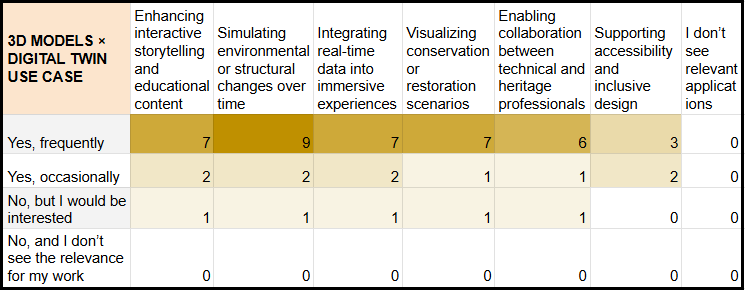
Figure 39. Cross-tabulation (use 3D models vs.areas where Digital Twins are considered useful).